By Ehren Reynolds aka @Sid-NY on discord
Working in technology support and IT direction for over 16 years, I’ve seen countless network topologies succeed and fail. When it comes to building a resilient, off-grid communication backbone for Western New York, the challenge is unique. We need a system that can handle our notorious lake-effect weather, cover expansive terrain, and remain reliable when traditional grids go down.
Within the BuffaLora community, we frequently get asked: Which is better, Meshtastic or MeshCore? The truth is, neither is inherently superior—it completely depends on how you plan to use it. That is exactly why BuffaLora fully supports both platforms.
As we gear up this spring to deploy new solar-powered nodes across public properties and county parks, understanding the differences between these two protocols is crucial. Here is the breakdown.
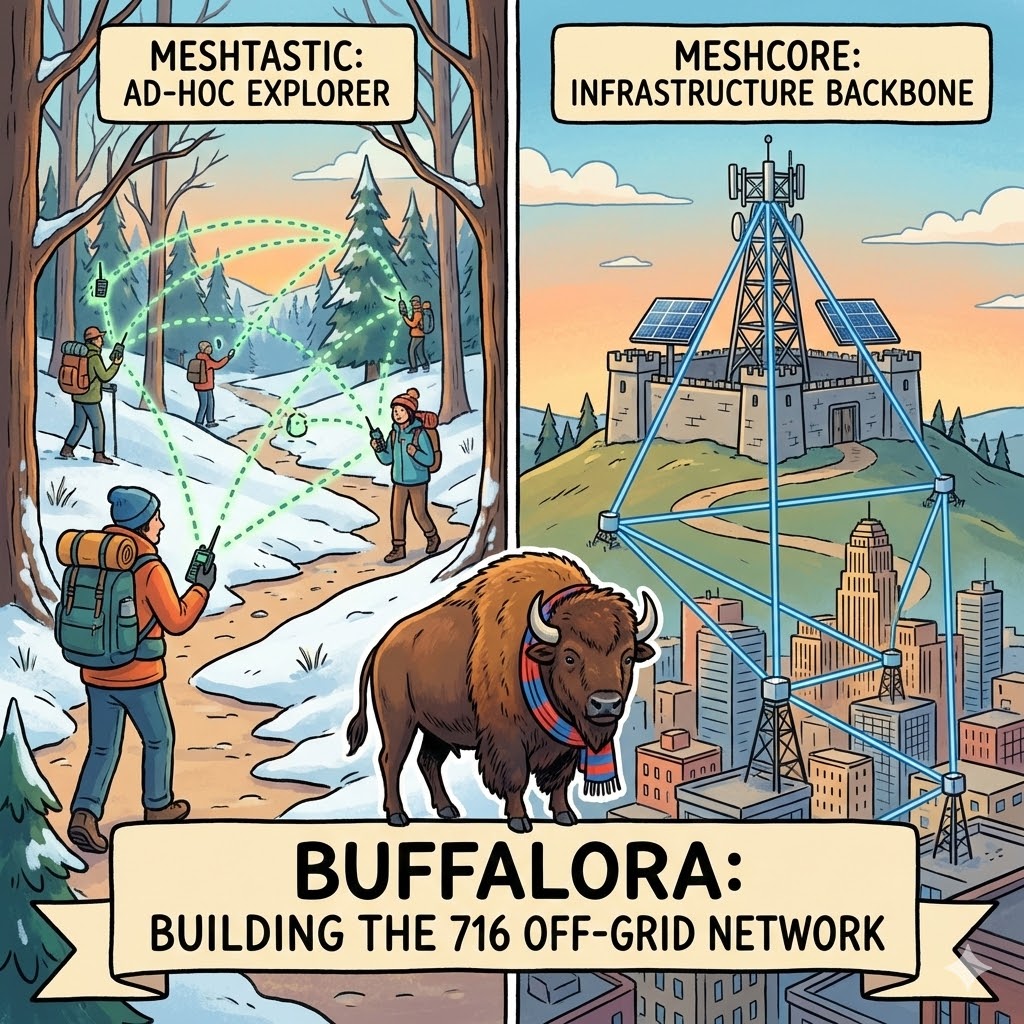
Meshtastic: The Ad-Hoc Explorer
Meshtastic is the undisputed king of accessibility and ad-hoc networking. It is built on a dynamic, peer-to-peer architecture where every single node on the network (even the one in your pocket) can act as a relay to bounce messages.
- Best For: Mobile groups, hiking, biking, or events where the network topology is constantly shifting.
- Routing: It utilizes a managed flood routing protocol, meaning messages are broadcasted out and repeated by participating nodes to ensure delivery.
- Hop Limits: By default, it uses 3 hops, with a maximum configuration of 7 hops.
- The Vibe: It is incredibly fun for beginners. You flash a radio, open the app, and instantly become part of a living, breathing mesh, collecting node contacts as you move around.
MeshCore: The Infrastructure Backbone
While Meshtastic is fantastic for mobile groups, a dense network of moving nodes can eventually lead to congested airwaves. This is where MeshCore steps in. MeshCore adopts a structured, hierarchical network design. Instead of every device rebroadcasting, MeshCore uses fixed, dedicated “Repeater” nodes to handle the heavy lifting. The radios we carry—called “Companion” nodes—do not relay traffic, keeping the airwaves clear.
- Best For: Fixed, static deployments like the solar repeaters we are mounting on rooftops and park structures across the 716.
- Routing: MeshCore utilizes static path optimization; it floods the network to discover a route, embeds that specific path, and only falls back to flooding if the direct route fails.
- Hop Limits: MeshCore can support an incredible 64 hops. This makes it vastly superior for covering the entire Buffalo metro area and beyond.
- Airtime Efficiency: MeshCore is intentionally less “chatty.” It rarely pushes telemetry data (like battery or temperature) unless manually requested, dedicating more airtime to actual text messages.
Why BuffaLora Supports Both
We recognize that the 716 needs both types of connectivity. If you are heading out to the gorge with a group of friends and need an instant, portable network, Meshtastic is your best bet.
However, if you want to connect to a highly reliable, city-wide backbone that functions more like standard SMS—powered by the stationary, solar repeaters we are actively deploying—MeshCore is the future of our regional infrastructure.
No matter which firmware you choose to run on your LoRa hardware, there is a place for you in our grid.
Learn More
If you are curious about the technical reasons behind this shift for infrastructure, check out this excellent breakdown from EmComm Solutions:
This video discusses the differences between the two platforms and what you should consider before picking the right one for your environment and use case.
 BuffaLoRa
One thought on “Meshtastic vs. MeshCore:”
Comments are closed.